

5 best websites to learn Business English in 2026
Do you want to learn Business English, but you don’t know which tool to choose? We’ve compiled a list of the best platforms and websites that will make learning Business English easy and enjoyable.
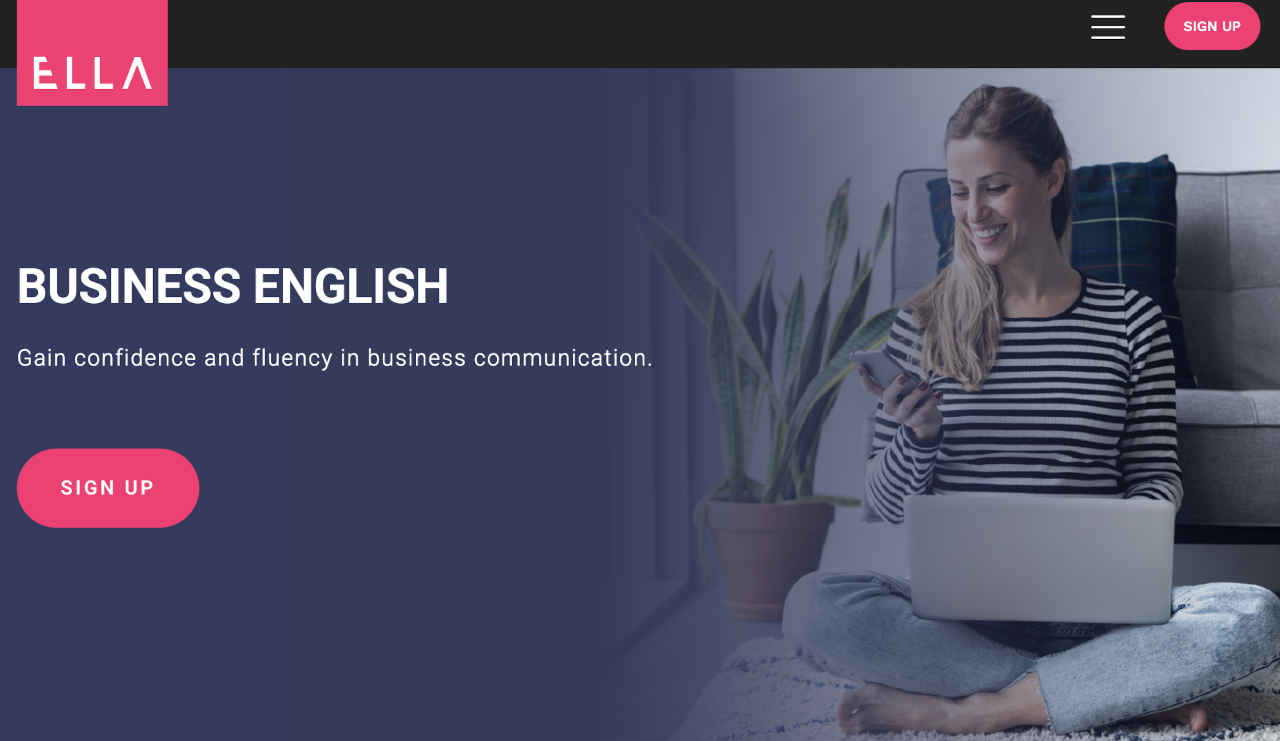
The ELLA platform: www.ellalanguage.com
The ELLA platform offers a dedicated Business English course.
Self-paced course
The ELLA Business English course is asynchronous, which means you can complete it at your own pace. You don’t have to fit classes into your schedule or the teacher’s schedule. What’s more, learning regularly in short bursts, which is easy to do thanks to the platform and will help you acquire English faster.
Short lessons
The lessons on the ELLA platform are designed to be completed in one sitting. Depending on the topic and level, a single lesson will take you anywhere from 15–30 minutes. The lessons are organized into thematic units that focus on a single Business English topic. Short lessons (in the form of micro-learning) will help you build a learning habit and memorize words and phrases more effectively.
Organized learning
The ELLA Business English course is a well-thought-through, structured course with verified, high-quality materials. The platform focuses not only on developing business vocabulary, but also on other competencies. It’s active learning through exercises, not just passive reading. Thanks to that, we can quickly see what vocabulary gaps we have.
Real language
ELLA focuses on everyday business language. Real dialogues and listening exercises allow us to immerse ourselves in Business English.
Choose your level
The Business English course is offered at B1–C1 levels. If you’re not advanced enough to take the course, you can begin with the General English course, which you can start from A1 (beginner).
Cost: $10 to $16 per month
The Economist: www.economist.com
The Economist is an excellent source of texts and videos that will allow us to expand our vocabulary in economics, politics, technology, finance or the labor market. The texts are well-edited and clearly structured. It’s not only a source of vocabulary, but also a great way to learn the structure of articles and other texts.
Cost: free basic access
What’s not great
The articles can be too difficult for learners at a lower English level. Sentences can be very long and sometimes hard to understand. The language in the articles is also not conversational, so it’s difficult to learn real, typical business dialogues. Articles in English are always worth reading, but passive reading without active exercises makes it hard to actually memorize vocabulary.
TED talks: www.ted.com
TED is a collection of talks on all kinds of topics. It’s an excellent source of videos that can inspire us and expand our vocabulary. TED’s advantage is that we can listen to natural language, not dry textbook dialogues. TED also allows us to familiarize ourselves with many accents, which is very valuable considering that most people we speak to in English every day are not necessarily native speakers. We can also turn on subtitles or follow the videos with a transcript.
Cost: free
What’s not great
TED helps us develop vocabulary and listening skills, but it isn’t an organized course in itself. We also don’t have specific exercises or vocabulary to remember—it’s just a collection of various words and phrases. We also never know what English level a TED talk will be. A2? B1? C1? If we choose a talk that’s too difficult, we might get discouraged and stop learning. TED talks are very high quality, but still, some non-native speakers make language mistakes, so there is a chance we’ll pick up something that is, in fact, a mistake.
Udemy courses: www.udemy.com
On Udemy, we can find many courses focused on business vocabulary. We choose a course we like, and it’s usually delivered through video. We can participate whenever we want. Courses usually also include materials we can download and/or short quizzes. Still, it’s a more passive form of learning than active learning. We also listen to a single teacher within a course.
Cost: $19.99 – $199.99
What’s not great
The main limitation of Udemy is the passive nature of many courses. We don’t really get language-specific exercises. The second limitation is that course quality isn’t verified, and neither is the correctness of what’s being presented. Often, courses don’t have a structured program and don’t really lead the user by the hand.
Coursera: www.coursera.org
Coursera is another marketplace where we can find Business English courses. On the platform, we can often try a course before we purchase it. Coursera also allows learners to apply for financial aid if courses are out of reach due to their financial situation.
Cost: $19.99 – $199.99
What’s not great
Just like on Udemy, course quality can vary significantly. We can find very practical courses, but also courses that aren’t very useful. Additionally, some courses have specific sessions or deadlines, which makes learning not fully asynchronous.